
Not all group education programs are the same. Here’s how the SMARTs programs go beyond sharing information about diabetes, and why a different approach can help participants build the skills and confidence they need to manage their condition, writes SHERYL MOORE.
Back in 2015, we consolidated our diabetes group education programs into the SMARTs suite, which were taken up by the NDSS and delivered across Australia. After running them for 10 years, we’ve undertaken a substantial review, and we’re now pleased to be rolling out a suite of updated and refreshed programs across Western Australia.
How diabetes education is delivered has a powerful emotional and behavioural impact.
Here at Diabetes WA, we’ve learned over more than sixty years of supporting people living with diabetes that simply telling them what to do when it comes to diabetes self-management can lead to frustration and disengagement.
Conversely, building a person’s confidence and capability can give them the skills and self-belief they need to live well with diabetes.
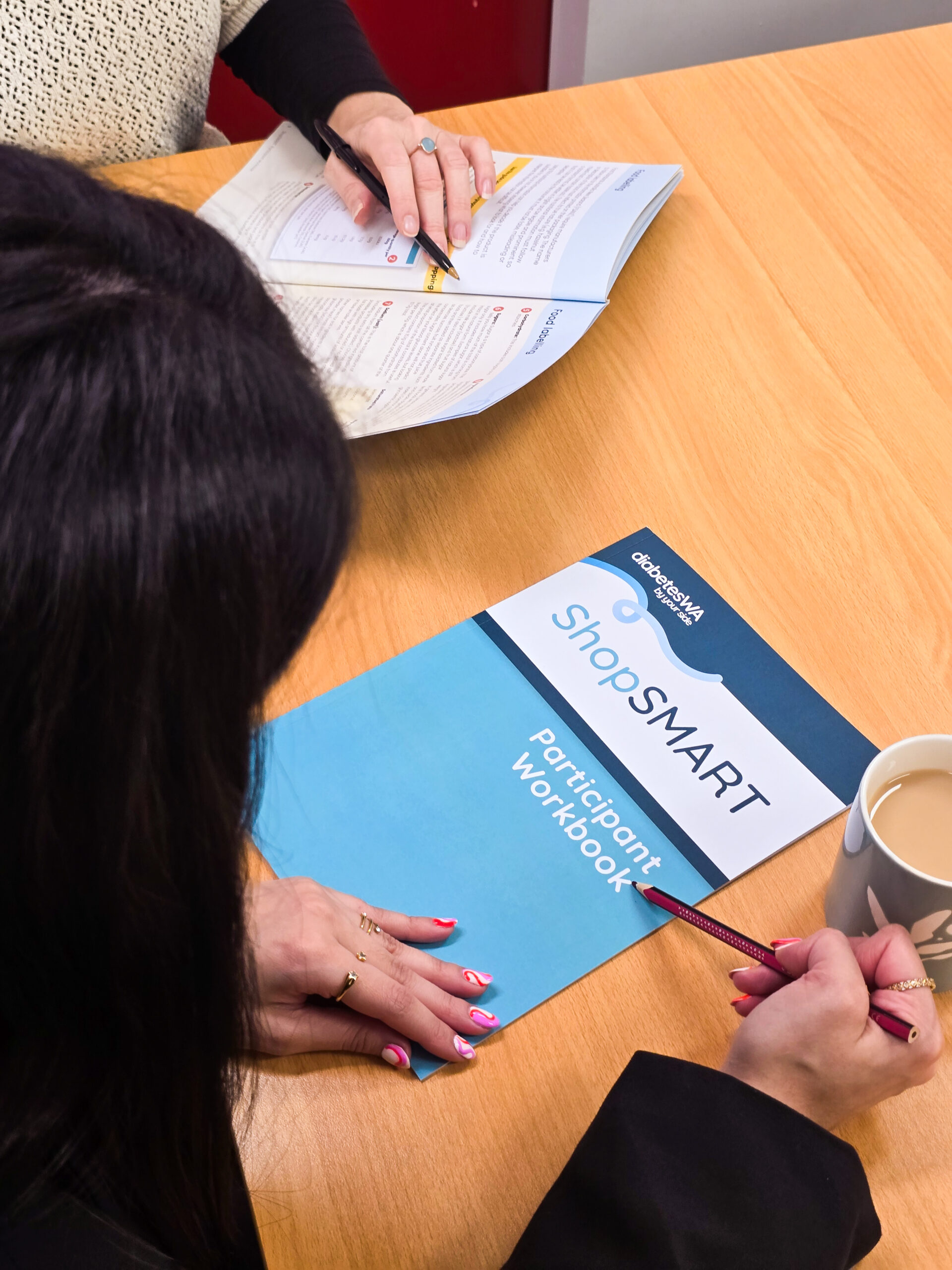
In developing the SMARTs programs in 2015 (FootSMART, CarbSMART, ShopSMART and MedSMART) we moved away from an ‘expert’-led model towards person-centred programs that build a person’s readiness to self-manage alongside their confidence and capability.
SMARTs facilitators take a ‘guide on the side’ approach, supporting participants to work through the program and identify a simple, achievable ‘Quick Win’ goal that puts these principles into practice.
When we train facilitators, who come from a variety of clinical backgrounds, our first activity gives them the opportunity to experience an ‘expert-driven’ learning style. We move quickly through a simple craft activity, skipping over key information and telling them they ‘aren’t keeping up’ and are ‘getting it all wrong.’
This training activity mimics what it can be like to live with a chronic condition and being told by ‘experts’ what you need to do without exploring how you feel and how this new information may or may not fit into your life.
We then invite facilitators to reflect – if you felt disempowered doing this simple craft activity for ten minutes, what might be the impact for someone trying to manage a chronic health condition over many years?
How SMARTs programs take a different approach
Central to the SMARTs philosophy is the belief that every person living with diabetes is an expert in their own life and will bring valuable knowledge and experience to the group.
Building a person’s self-efficacy, or belief in their ability to manage diabetes, is the central intent of the program. This is because we know that self-efficacy drives behaviour change, and behaviour change drives diabetes outcomes.
Self-efficacy determines whether someone tries, how they feel when they are trying, how they respond to setbacks and whether they maintain a behaviour long term – whether that be healthy eating, footcare, medication adherence or regular physical activity.
Patients with strong self-efficacy report lower emotional distress and better psychological wellbeing, while lower self-efficacy is associated with feelings of helplessness and poor mental health, which have a negative impact on diabetes management.
This client-centred approach is collaborative and non-judgemental. We know that in encouraging clients to get involved in the session rather than being ‘educated’ we see increased confidence in managing diabetes. We want people to leave a SMARTs session feeling less reliant on health professionals telling them what to do and with a stronger sense of their own abilities.
Building self-efficacy
Developed in the 1970s by Albert Bandura, social cognitive theory identifies four primary sources from which self-efficacy is built: skills mastery, role modelling, verbal persuasion and affective state. Ideally, people will carry this expanded self-efficacy from the program and into their daily life. Let’s look at how these sources work together to strengthen self-belief:
Skills mastery involves having the opportunity to practise a task and experience success, often by breaking it down into smaller, achievable steps that build confidence. A collaborative workshop that encourages interaction with guidance can help people to achieve this.
Role modelling is seeing people who are similar to oneself, successfully complete a task. By keeping groups to between 5 and 20 people, we ensure diversity of experience and backgrounds while not letting the group become so big that people aren’t able to participate meaningfully.
Verbal persuasion, or encouragement, can happen naturally in a small supportive group. As well as hearing positive feedback from others, it involves helping people challenge self-doubt and reframe unhelpful self-talk, building their confidence to try new tasks and manage setbacks.
Affective state refers to our emotional and physical reactions, which can either support or hinder diabetes self-management. Feelings such as stress, anxiety, frustration or confusion may act as barriers to behaviour change and self-care. Workshops actively encouraging individuals to discuss and explore these in a safe space enhance self-reflection and help them recognise the impact their emotions may have on managing their diabetes.
Bringing the group together
When facilitating a SMARTs program, participants are encouraged to interact with the program content and each other. Key to this is our trained facilitators, who are equipped to do more than simply deliver information.
Drawing on behaviour change principles, the less the facilitator talks, the more engaged participants become in discussions. Facilitators act as guides rather than experts, encouraging participants to reflect on their beliefs and experiences and share them with the group to problem solve and build confidence in their own knowledge and decision making. To support meaningful interaction, we aim for participating numbers between 5 and 20, with an optimal group size of 8 to 12.
Facilitators create an environment that helps participants feel supported, capable and confident by checking in with them, going at the right pace and encouraging them to share knowledge with one another.
While we want to meet participants’ expectations and increase or update their diabetes knowledge, SMARTs programs go beyond this by empowering them to engage in positive behaviours, whatever that might look like for them. Key to this are goal-setting techniques, woven throughout the program, which help participants to identify what matters most to them so they leave with a practical action they feel confident to try.
To help participants develop the skill of prioritising, we conclude each program by asking them to identify just one thing that is important to them that they would like to try or change. While it’s good to have a goal, it’s more likely to be achieved if potential barriers are explored. By leaving with a self-selected goal, a plan for achieving it and coping strategies at the ready for dealing with barriers, participants can put their learning into practice and build confidence in their ability to manage their diabetes.
SMARTs programs go beyond sharing information about diabetes. By combining evidence-based content with strategies that build self-efficacy, they help participants move beyond knowing what to do to feeling capable of doing it. For health professionals, this means conversations can shift from providing information to supporting people to take meaningful action.
Would your patients benefit from a SMARTs program?
If you support people living with diabetes, consider referring suitable clients to the SMARTs programs. The knowledge, skills and confidence they gain may benefit not only their self-management but also the ongoing partnership they have with you and their broader healthcare team.
The programs complement individual education and are free to attend. They are provided in local community centres and participants can bring a support person.
Please visit our SMART page to find out more.